MakeMyTrip
MakeMyTrip
Designing Connected Travel When Direct Routes Don't Exist
Designing Connected Travel When Direct Routes Don't Exist
Context
Context
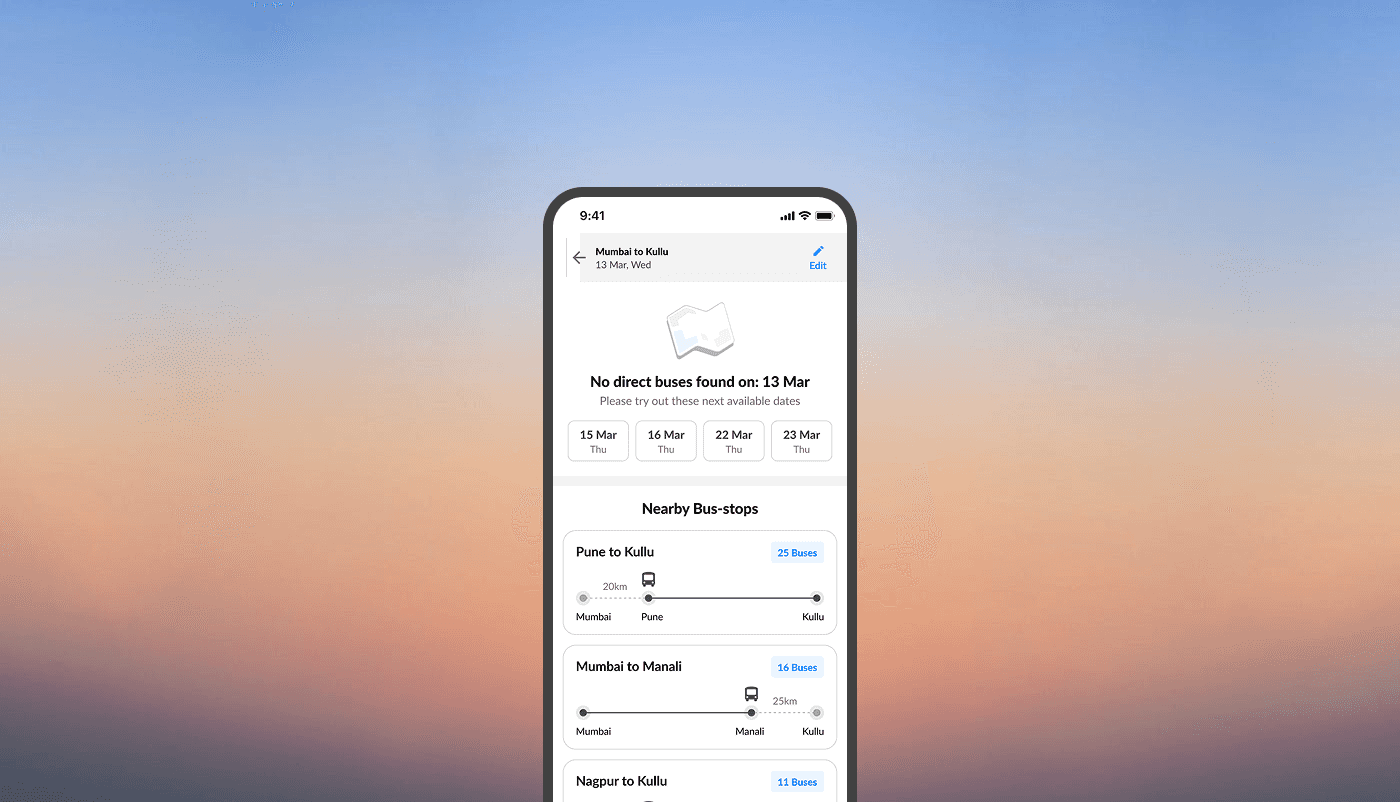
In 2016, booking a bus on MakeMyTrip felt straightforward: search a route, pick a bus, done. By 2024, that simplicity masked a critical failure. When no direct route existed, users hit a wall and disappeared.
I redesigned the bus search experience to preserve journey ownership when direct routes failed, recovering thousands of drop-offs without adding a single new bus to the network.
The Rigid Assumption
The Rigid Assumption
MakeMyTrip's bus booking experience was built around a fundamental assumption: a direct route exists between any two cities a user might search.
When that assumption held true, the experience worked beautifully. But when it failed-when someone searched Mumbai→Kullu or Delhi→Goa and no direct bus existed-the entire system broke down.
Users saw a static "No results found" screen and were left to figure out their next step alone.
The Problem: Loss of Journey Ownership
The Problem: Loss of Journey Ownership
From a conversion funnel view, this manifested as a ~2.5% drop-off in total bus searches. Product leadership recognized we couldn't solve this by adding routes-operators couldn't economically fill these gaps. Many were seasonal routes, low-demand corridors, or simply unprofitable.
The brief was clear: "How do we avoid losing these drop-offs without influencing operator supply?"
We had to design our way out of a structural constraint. When we analyzed what users actually did after hitting the dead end, four distinct patterns emerged:
Mapping the Broken Journey
Mapping the Broken Journey
To visualize these failure paths, I mapped four distinct user journeys that emerged from the no-results state:
Key insight from these journeys:
Users showing flexibility (date changes, city modifications) were being punished with manual trial-and-error. The system had the data to help them-it just wasn't surfacing it.
Reframing the Opportunity
Reframing the Opportunity
The data showed something we hadn't anticipated: users weren't blocked by demand or intent-they were blocked by the interface treating travel as siloed verticals when users experienced it as one continuous journey.
Instead of asking "How do we add more routes?" we reframed:
How might we help users complete their journey even when a direct bus doesn't exist-without forcing them to start over elsewhere?
This shifted the goal from saving a bus booking to preserving the journey.
Information Architecture: Before vs. After
Information Architecture: Before vs. After
ABC:
ABC
The Constraints That Shaped Everything
The Constraints That Shaped Everything
Before jumping into solutions, I needed to understand what couldn't change:
1) No New Supply
We couldn't ask operators to fill dead-end routes with new buses. The economics didn't work.
2) Minimal Engineering Effort
This had to be This was a design intervention with outsized impact. Backend re-architecture and heavy engineering lift were off the table initially. The business case required "low effort, high reward."
3) Platform Prioritization
We could only launch on one platform first. With ~65% of MakeMyTrip traffic coming from mobile, and bus travel skewing heavily toward on-the-go planning, mobile was the obvious choice.
4) Future Multi-Modal Vision
Leadership wanted to eventually connect bus + train + cab into unified journeys. This meant designing with scale in mind. Solutions needed to work for future vertical integration without requiring a complete rebuild.
These constraints forced us to be surgical about where we intervened.
Early Exploration: Learning What Didn't Work
Early Exploration: Learning What Didn't Work
We started by testing the most obvious solution: show everything at once.
Attempt 1: The "Kitchen Sink" Screen
Attempt 1: The "Kitchen Sink" Screen
Our first prototype combined all of these in one screen:
Date flexibility options
Connected bus routes
Train alternatives
Cab alternatives
What happened:
Users took time just trying to understand the options before interacting. 1 out of 10 quit out of frustration. 3 out of 10 said they didn't know which option to choose.
The more options we gave users, the harder it became to make a decision.
Attempt 2: Auto-Correcting Dates
Attempt 2: Auto-Correcting Dates
If no bus was available on March 13, why not just show results for March 15 automatically?
We built a prototype that auto-adjusted dates when no direct bus existed.
What happened:
3 out of 10 users only noticed the date had changed when they reached the review page. They had to go back and start over.
User quote: "It would be better if you told me earlier. This wasted my time. I'm not flexible with dates."
Attempt 3: Tabbed Navigation
Attempt 3: Tabbed Navigation
To reduce information overload, we separated options into tabs:
"Stops near Mumbai" (showing A → B' routes)
"Stops near Kullu" (showing A' → B routes)
What happened:
Users couldn't compare total price and travel time across routes without switching tabs repeatedly. The back-and-forth became tedious. Users spent more time per screen but made slower decisions.
The System We Built Instead
The System We Built Instead
After three failed attempts, we landed on a prioritized, unified approach that balanced guidance with control.
Design Principles
Do the heavy lifting for users. Use data to recommend the best options.
Make comparisons effortless. Show routes together, not in tabs.
Respect user agency. Never auto-correct. Always explain why we're showing alternatives.
Design for the journey, not the booking. Preserve context across transfers.
The Recommendation Algorithm
The Recommendation Algorithm
To make this work, we needed an intelligent way to prioritize routes. I worked with data science and the PM to build a recommendation system.
My Contribution to the Logic
The data science team delivered the base algorithm considering time and price. When two routes were equal on those dimensions, I worked with the PM to add qualitative factors:
Prioritize daytime transfers over overnight waits
Prioritize stations with amenities (waiting lounges, restrooms) since extended waits reflect on MakeMyTrip's service quality
Surface previously booked routes by other users as social proof
This collaboration shaped v2 of the algorithm, making recommendations not just mathematically optimal but experientially sound.
Reflection: Designing for Broken Paths
Reflection: Designing for Broken Paths
This project taught me that most design effort focuses on happy paths. But the highest-impact opportunities often live in failure states, the moments when a system breaks down and users are left to recover on their own.
By designing for continuity instead of conversion, we:
Reduced leakage to competitors
Preserved context and intent
Introduced a journey-first mental model that will inform MakeMyTrip's multi-modal future
What Worked
What Worked
Using behavioral data to guide system boundaries (not assumptions)
Prioritizing journey continuity over siloed funnel metrics
Showing messy iteration (failed tabs, auto-correction mistakes) to arrive at the right solution
Fighting for the one engineering investment that mattered (combined booking flow)
What I'd Do Differently
What I'd Do Differently
Test transfer instructions earlier. We refined the "2 km within 4 hours" messaging late in the process. Earlier testing would have surfaced edge cases (nighttime transfers, rural stations without signage).
Invest in operator communication. Some operators didn't initially understand connected bookings, leading to confusion at transfer points. A parallel communication strategy would have smoothed the rollout.
Industry
Banking
Client
Booking Corp.
Fintech Dello Banking App. New Way to Empower Life
Revolutionizing Banking: Enhancing User Experience with the Dello Fintech Banking
In an era where seamless digital experiences define user expectations, the Dello Fintech Banking App emerges as a beacon of innovation in the financial technology landscape. This case study delves into the user experience (UX) design journey undertaken to transform conventional banking interactions into intuitive, efficient, and user-centric experiences.
As traditional banking institutions grapple with the evolving demands of a digital-savvy clientele, Dello steps forward with a visionary approach to redefine how users engage with their financial resources. The intersection of cutting-edge technology, user-centered design principles.
Elevating Financial Experiences: Dello Fintech Banking App's Impact and Future Endeavors. Financial Experiences: Dello Fintech Banking App's Impact and Future Endeavors.
As the financial technology sector continues to evolve, the Dello team remains committed to ongoing improvements and innovations. Learn about the future roadmap of the app, exploring upcoming features, integrations, and strategies to stay at the forefront of user-centric fintech solutions. The Dello Fintech Banking App serves not only as a testament to the power of thoughtful UX design but also as a harbinger of what the future holds for seamless, secure, and enjoyable financial interactions.
Connect to Content
Add layers or components to infinitely loop on your page.